
Interview With Vivian Tseng
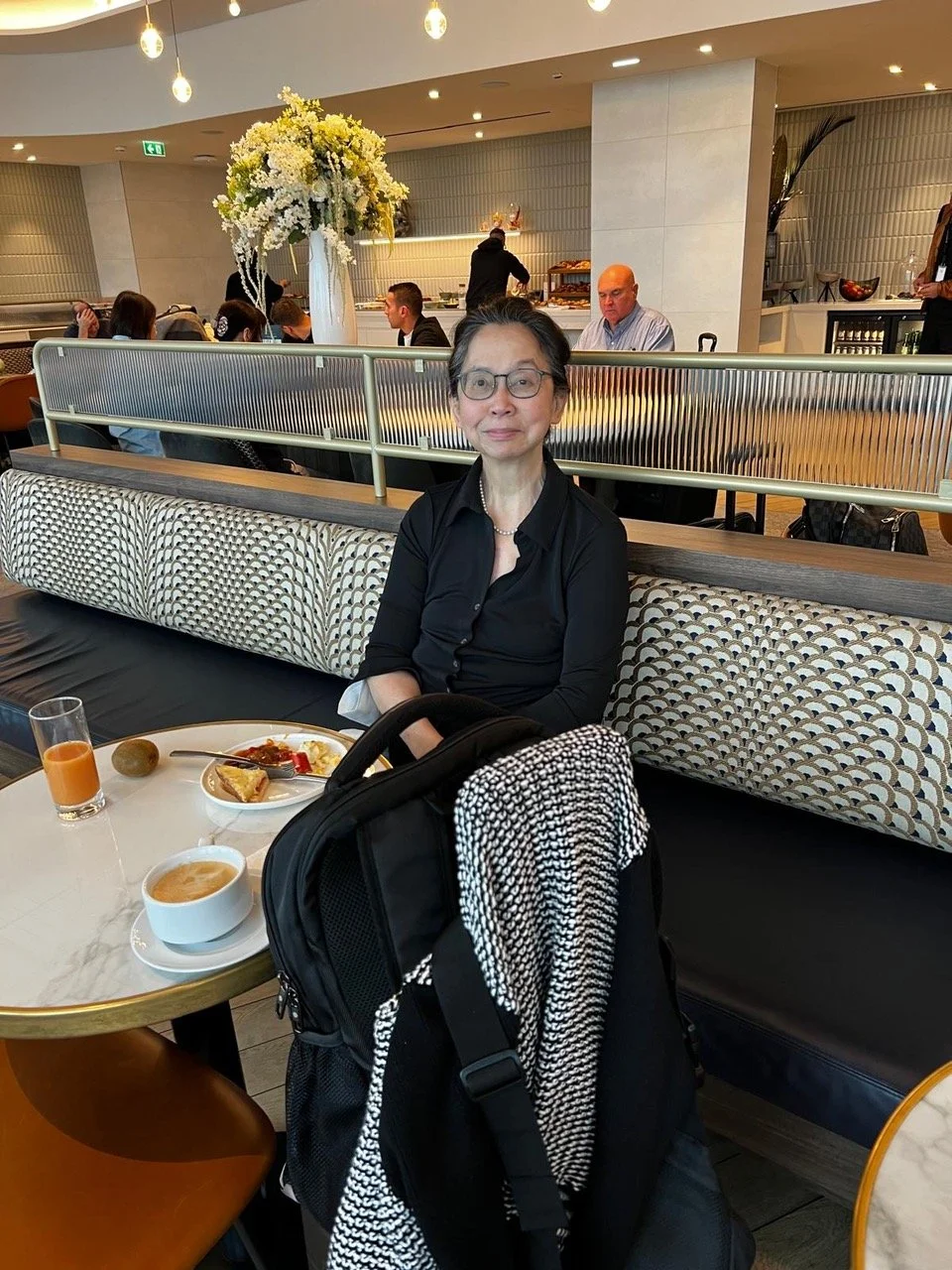
Vivian Tseng is a longtime political activist and one of our very own GMAACC board members. Recently, I had the opportunity to interview her. During our conversation, we spoke about Asian American political advocacy, as well as the evolution of identity, and what it takes to be involved in your community.
— Abby
Me: How did you first get involved in GMAACC, and what drew you to this organization?
Vivian: Well, you know, one of GMAACC’s founders is Mai Du, and she's a great convener of people. I think she and I became involved in another organization, CARE. Have you heard about CARE—Coalition for Anti-Racism in Education? A bunch of us gathered together shortly after the height of the anti-Asian hate during the pandemic and the aftermath of the Atlanta shootings. Nationwide, there was a response from the Asian American community, and there was an interest in introducing Asian American Studies in a lot of schools, in a lot of jurisdictions. I and other folks in Massachusetts thought that, you know, we needed a broader approach and the education was the correct approach, but it needed to be broader beyond Asian American Studies
And so we came together as CARE, calling for an inclusive curriculum for all to address bias to address the central problem of bias and discrimination. Then I moved from Concord to Malden, and Mai encouraged me to join the board of GMAACC, recognizing my prior history as an organizer and political activist. Somebody who believes in Chinese American political social voice, and who believes in promoting the wellbeing of the Chinese American community.
Me: So you already had a previous interest in both Asian American political advocacy and also Asian American Studies, the education side?
Vivian: I'm a lifelong political activist. I'm 74 years old now. I grew up in the anti-Vietnam war era, which you may or may not know—in the late sixties, early seventies, the youth were very, very politicized by the war in particular, and the cultural revolution of a different way of living. That's the era in which I grew up. And graduating from high school and going to college, I just became politically active with my fellow Chinese American and Asian American friends and cohorts. That was the beginning of the Asian American political movement that gathered steam year by year, with events like the Vincent Chin murder and how that was treated horribly by the court.
I was just very much part of all of that, all of those activities. I grew up in Maryland, and between high school and college and during the summer months while I was in college, I was active. I hung out in the DC Chinatown. We started a newsletter called Eastern Wind, and I wrote for the newsletter about women's liberation and about the Asian American political voice. So since I was in my late teens, early twenties, I was a political activist focused on Asian American rights and racial justice issues.
Me: How did your family come to reside in America to begin with?
Vivian: Oh, I know all about it. In many respects, I feel that my family history mirrors Chinese modern history. My parents grew up in a province that's in the southern part of China, sort of north of Canton, the very famous Chinese province. My father was a member of the nationalist party, and they were very much part of the Civil War narrative. My parents evacuated to Taiwan in the aftermath of the Civil War, and my father was appointed a member of the State Department—the foreign service department of the nationalist government in Taiwan.
He was assigned a position with the Chinese embassy, when the government of Taiwan had an embassy in Washington DC (before Nixon went to China and before the rapprochement between the United States and the People's Republic of China). So that's how we came to the United States.
I grew up in DC and later on, when my family moved, in Maryland, I think I was in elementary school in DC and then middle school and high school in Maryland. My parents' province was actually the seat of the first Soviet of the Chinese Communist Party, so it saw a lot of war during the Civil War and during the Japanese invasion of World War II. The war trauma that my parents and my grandparents lived through is very much part of my family history.
And it's something that my mother shared, and something that entered my heart and my soul at a young age. It’s a history that I carry with me, a sadness that I carry with me. My mom was very, very close to her mom. She was the only girl in her family. You know the second status of girls in traditional Chinese families—my mother's upbringing was the exception to that. She was a very cherished daughter, cherished but not spoiled. And that's very much again part of my heritage. I mean, even today I feel, talking to you, the grief of my grandmother when her daughter left her, and I just remember my mother's telling of that story. She told me that story again and again and again, and to this day, it remains fresh with me. I can feel so freshly my grandmother's knowledge that she was never gonna see her daughter again, and my mother's naivete at that time thinking, oh, you know, I'll be back. That last time they were together, that goodbye, that disparate knowledge between mother and daughter—I don't know why but it's very, very fresh with me. Maybe a psychological therapist will provide that explanation. But my devotion to GMAACC—in the building of the community center as a home—is just so rooted in that rupture of my family, which is reflective of so many Chinese families by reason of the events of modern Chinese history.
Me: I think there's a theme of separation in a lot of Asian American narratives, there's that sorrow that gets passed down. To tie it back to GMAACC—I feel like there’s a sense of belonging that we search for, and that we are able to get through these organizations and the work that they do.
Me: Has your understanding of your Asian American identity or your Chinese American identity changed over time?
Vivian: That's a really good question, and it's a big question. I have to think back to when I was a teenager, when I was a young adult, when I was a young professional.
It's grown and evolved. I often say that I've walked in my life through the world alone, because I so often found myself as the only person in any given space with my particular traits—by gender, by race, by ethnicity. My parents being immigrants—with an uncertain grasp of English and a lack of knowledge about American society and its ways—meant that when I and my siblings stepped out of the door of our home, we had to navigate the outside world independently and make our way. I think we each sort of made our way individually and differently, just by reason of our different personalities and experiences.
To talk about the growth of my Chinese American / Asian American identity and its changes, it could be instructive to contrast my personality and experiences with those of my siblings. I am the youngest in my family. We are a family in the United States of four siblings; I was eight years old when I came to the States, my sister was 10, and my two brothers were respectively 12 and 14. And I mention that because I became the most Americanized. To this day, I mean, we've been in the United States for close to five decades, and my siblings still, I think, have a posture of being an outsider. I don't know that they fully think of themselves as Americans as much as I do.
I think my sense of my identity has evolved from being an outsider to being an insider. You know the euphemism a seat at the table? Where I may have once approached that mythical, allegorical table (representing civic and social participation) gingerly and with some hesitation, waiting for an invitation, I slowly abandoned that approach to one of very confidently, aggressively claiming my seat at the table. Taking it as my right and taking it unabashedly.
I would just say that my voice has grown through the years with confidence, and my understanding of how everything works has perhaps grown in breadth and depth over the years. I'm a retired lawyer, I was in private practice and then I spent the bulk of my legal career as general counsel of a mid-size company. It was an intrigue into, quote, “the upper echelons of our society.” I worked for big law firms, and if you have any exposure to the legal world and the hierarchy of the legal world, big law firms represent the elite of American business and civil society. And so I entered that world—as general counsel, I was an observer. I did corporate lobbying on Capitol Hill for my company, and actually I also worked on Capitol Hill between college and graduate school before law school. I learned a lot about the law and government and how things work, and that just all fed into my advocacy for representation, equality, racial and gender.
Me: What does your involvement these days look like?
Vivian: I'm sort of active in four different political organizations. CARE and GMAACC are two of the four.
I am on the leadership team, so I think of myself as a thought leader. I am grateful that my fellow activists are very committed, very energetic. They tend to be younger, which is why they have a little bit more energy than I do. I help strategize, I help think through approaches. I write things, you know, if we need a position paper, if we need a letter to the editor or any kind of written response. Our central project [at CARE] is getting legislation through the Massachusetts State legislature for a certain type of curriculum content that would be inclusive of histories and experiences and contributions of marginalized groups, and I help draft that legislation.
That's the kind of thing I do. It allows me to be part of many different organizations. In all of the four organizations that I belong to, the work is spread among many people (many hands make for light work). So I can do my part, and others do other parts.
Me: Given that you work with a lot of young people, do you have any advice for the younger generations of people who are interested in getting involved with Asian American advocacy?
Vivian: First and foremost, I think it's important for you to be two things. You need to be in community. You might have a busy period when your capacity may shrink or expand through time, but never leave the community. Even if you're only able to go to one meeting, do that, because what is deadly for an activist is to be alone. Because when you're alone, you get discouraged, it seems overwhelming, and it seems like the task is too large. Being with others of like mind and shared goals and commitment bolsters me. It makes me feel better, and it motivates me to do something, be that large or small.
So remain in community, number one. And then number two is to stay in the arena. I have gone through periods in which I was passive, and then I would go back, and I always felt better after I went back. I remember after Trump's first election, I figuratively crawled into bed and pulled a blanket over my head for like a month. But then I came out, and I joined the local chapter of Indivisible, of other like-minded people who also picked themselves up. Many of them are veterans of the women's March in 2017, and who were galvanized by that momentum to be politically active.
Let me mention the Asian American Lawyers Association of Massachusetts. I'm still a member. I'm sort of in the founding class of that organization, and I'm just a member who goes to the occasional social gathering. All of us are a core group of people who were part of the founding class; we’re still close friends. One of them, like me, continues to be a political activist all his life. His name is Paul Lee, and he was one of the honorees at our gala last winter. So, you know, my history is not unique.
Paul is also a retired lawyer, and he remained politically active during his professional career as I did. He was working toward ethnic / racial representation of Asian American and Chinese American lawyers in the legal profession. And I was speaking about gender representation and racial representation in the legal profession. It's really just very viable to have activism be part of your lifelong story. Paul and I would both say the same thing. We feel so very blessed to have had that. It’s enriched our lives, and we both like to say we made our best friends through political activism.
Me: What would you say is the role of GMAACC in this sphere of political activism? Not that GMAACC is specifically in itself an activist organization, but what do you see as the importance of GMAACC in this ecosystem?
Vivian: I think GMAACC is first and foremost a local voice for the greater Malden area. GMAACC began as an important political, civic, and social voice for the Chinese American community in the greater Malden area. We are a social welfare organization, in addition to being a political advocacy. The Ping Pong Club, which by its name may not sound really important, is very critical because it provides a home, a gathering place for especially older Chinese Americans / Asian Americans in the greater Malden area. I think it's very important for us to provide that social space for people to come together and see that they're a member of a larger community.
I think of our two senior citizen groups, the dance group and the ping pong group, as the pillars of GMAACC, and we are advocates. We have spoken up for the community when the community needed defense. During the pandemic we also provided aid and food distribution. And when they were racially motivated incidents, we were the voice to speak up against that. Once in a blue moon, somebody would have a grievance with maybe a city agency, and they would come to us and we would say, okay, we would look into it, and we would speak on their behalf. That's what we have been and will continue to be, and we look to expand that capacity.
Right now, all of our focus is on building this community center, which we think will be so impactful for the greater Malden area. There was an op-ed, I think in the Boston Globe, by Ben Hires. He is the president of BCNC, Boston Chinatown Neighborhood Center. Did you read that opinion piece? It was about gambling in the Asian American community.
Me: I did actually once talk to someone from BCNC. She told me that the importance of the social clubs like ping pong is actually to help combat the gambling specifically.
Vivian: Exactly, exactly. [The op-ed] was criticizing the Commonwealth and Encore for not living up to their promise of helping gambling addiction in the Asian American community. There’s a quote by gamblers, who say they go to Encore for community, in order to socialize, 'cause they have nowhere else to be where there are a lot of other Asians. I thought, oh my god, you know, this just underscores the tremendous need for something like an Asian American community center. And so that's been in my heart, a rallying cry to really work very, very hard to get this building up and running.
Me: What does home mean to you?
Vivian: Well, I'm gonna rely on that old saying, home is a place where you go, they have to take you in. I don't know if you're familiar with that quote. In a broader sense, it's where everybody knows your name, that thing from Cheers.
That's how I envision our community center. It’s when you walk through that door, you're greeted by name, you're recognized, and you're welcome.
