
Interview With Shark Lao
I recently sat down with GMAACC’s newly-appointed Community Development and Narrative Strategy Fellow, Shark Lao. Born in Pasay City and raised in Davao City, Philippines, she brings a background spanning veterinary medicine, environmental science, and sustainability design, with a focus on marine conservation, interpretive design, and co-creative storytelling tools that help communities protect what they love and imagine more just, resilient futures. In our conversation, we talked about art, sustainability, and the experience of diaspora.
— Abby
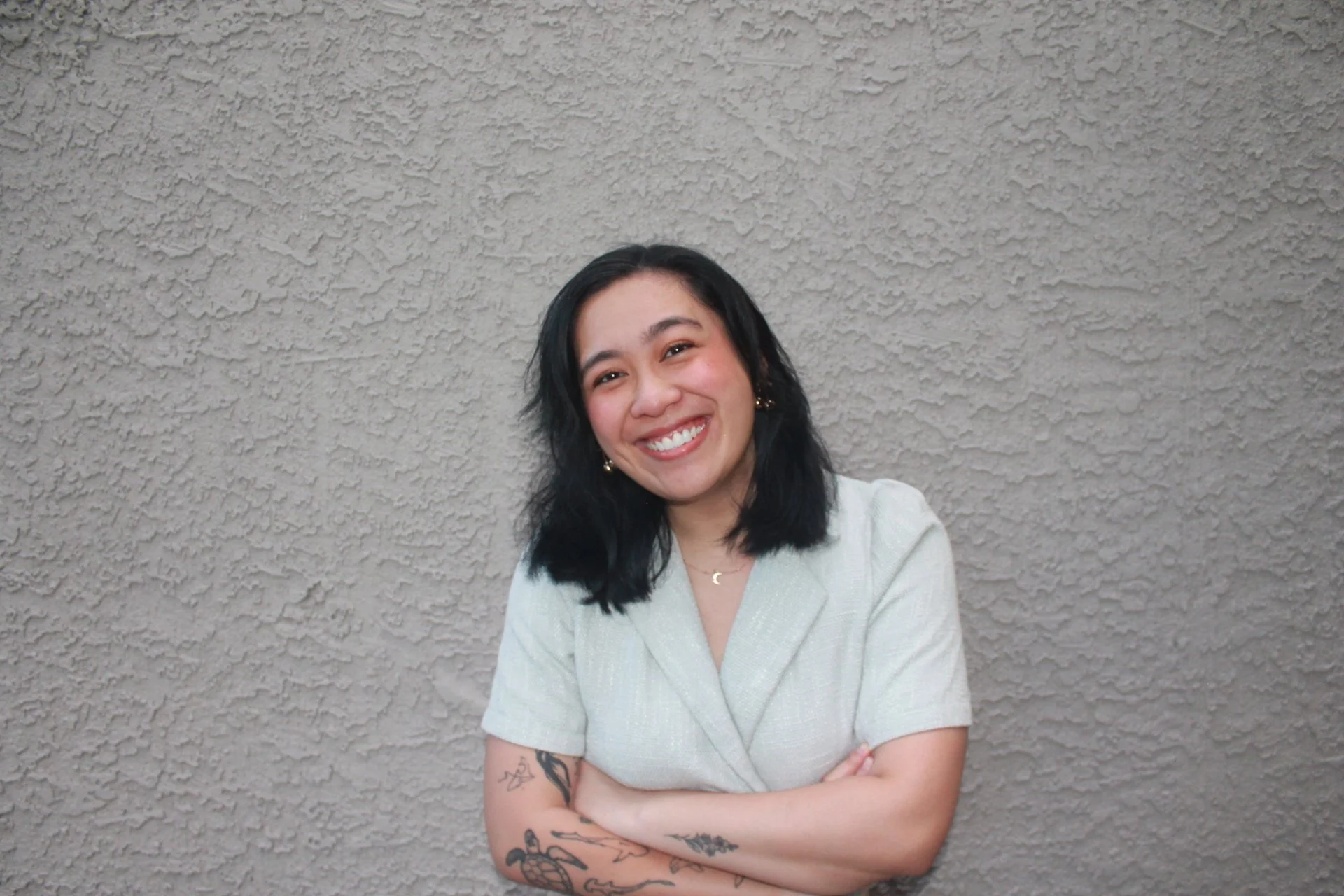
Me: It’s so nice to meet you! Could you briefly introduce yourself?
Shark: My real name is Louise, but most of my peers and family call me Shark. I'm originally from the Philippines, and then I moved to Savannah, Georgia, for my master's in 2022. I lived there for a few years, moved to Albuquerque, New Mexico, and then recently moved to Malden, Massachusetts a month or so ago.
Me: How did you first get involved with GMAACC
Shark: Funnily enough, Mina was actually walking outside Gallery 57, and she [got] my aunt and my uncle to attend one of the workshops they were hosting, so that's kind of how we met. I reached out, was super interested with what GMAACC has been doing and was hoping to get involved, and eventually here we are. Now I'm GMAACC’s Community Development and Narrative Strategy Fellow.
Me: I didn't know that you met because of the book workshop event!
Shark: Yeah, I had just moved here—I am in the job hunt still—but I’d been looking for more meaningful ways to help the community that I live in, and always wanted to be more involved in creating that sense of belonging, which is exactly what GMAACC does for AAPI communities.
That's something that I struggled with when I lived in Albuquerque. I did not make a single Asian friend, much less a Filipino friend, and I've always kind of craved that connection, connection with other people and connection with my culture as well. That's kind of what brought me to GMACC.
As an artist, what influences your art, or what are you inspired by?
Shark: I feel like I've always been on such a non-linear path in my career. I was in veterinary medicine, and my parents are also veterinarians, so the typical path they expected of me was also to pursue veterinary medicine, and post graduation just take over like the family clinic (they're all excited to retire). And I have always loved the arts. I used to dance ballet, I've been a ballerina since I was two. I love art—it's my main outlet to be just myself. But you know, typical Asian family, they don't really see art as a career path, so I kind of just had to stick through veterinary medicine and finish that, and then do what I want.
I went through that, and then eventually I discovered that I'm more into marine conservation, and to do that I needed to understand more of the environment, sustainability, and how ecosystems work together. So, after my first undergrad, I did environmental science and policy science, and through that I did start working for a grassroots nonprofit, helping them draft policy.
I realized that I need more than the science and the hard, complex theories and concepts that I've learned, to really convince a larger group of people to understand why these environmental issues matter. That's how I got more into design, and I did my master's in design for sustainability.
We in sustainability, we all talk about ESG—Environment, Social, and Governance. I've worked in Environmental, I've worked in Governance, but I feel like I missed the Social bit, which is the people bit. During my master's, I tried to focus on understanding behavior change. And all the design projects, all the things that I've done, I realized, have always been infused with art, so it's really like bridging the science with the art. I have all the science, but art and design have always been the medium to actually translate that into something that someone who is not in sustainability would understand. That kind of got me into more community work.
I think people have this misconception of sustainability as a concept that only people who work in sustainability should be working on, like “you need to study this path in order to make contributions in sustainability.” But I think other things like community and focusing on individual well-being also contributes to that larger picture of sustainability.
And then the culture comes in. I was born and raised in the Philippines, but I'm Chinese, so even navigating life in the Philippines with a lot of Filipino classmates, but learning Chinese culture at home, was challenging. I grew up pretty Filipino as well, so just managing cross-cultural identities and also moving across the globe to the US has always been a struggle for me. I think that I battled with it for a while after moving here—it's kind of hard to find where I fit in—until I realized a few things. One, I don't really have to make myself fit in, it's my identity and how non-linear my path has been that contributed to who I am today, what I enjoy doing, and what is fulfilling for me. And second, I also have the power to make that space for myself and for other people.
So despite the non-linear path, all the tools that I've learned, all the frameworks and all the projects that I've worked on just going with the flow, have equipped me with a better understanding of myself. And better understanding and accepting myself helps me make better events for people. Whatever I crave, I kind of figure that “oh, I'm not the only one,” so it's kind of easier to gauge what types of activities would also fill other people's cups.
Me: What sort of arts projects are you currently working on?
Shark: Well, on the side, I founded a design studio with my aunt. We mostly do stuff around sustainability, design, and art. One of our biggest projects yet was an art show for Climate Week New York City. I took my thesis and turned it into a more immersive art exhibit, presenting the findings in a more interactive way. I gave the work to a bunch of different artists and told them to interpret it the way they want to in their best medium. That kind of strengthened the emotional connection bit for the ocean, because I realized when I moved here that there's a population of this world that hasn't seen the ocean.
Ocean or marine conservation is a harder sustainability field to get people on board with, and I never figured that it's because not everyone lived or grew up the way I did—literally surrounded by water. To me, it's common sense because I've seen it. I've lived beside the water, and really saw firsthand how the corals were bleaching, or how trash is piling up on the shore. How flooding has been more frequent, how fishermen are always competing with larger commercial commercial fishing vessels that disrupts livelihood, the effects of eco tourism, and things like that. So me bringing in my study, and my work with the local community of Donsol (which is a province in the Philippines), helps me give a different platform for that local knowledge that I want to preserve. The whole project was designed with and for the community, and being able to show that as a case study makes the research a replicable model for other ecotourism sites. It was really an exhibit showcasing “hey, I was able to do this with the local community, you can do this too, and there are lots of great ways that you can inspire conservation.”
We had a mini symposium happening at the same time, and while it was marine focused, we also had organizations in food security and climate vulnerability, and they were mostly there to host a talk and a panel. There was a little bit of something for everyone—every part of the room kind of sparked conversation for everyone, and that's exactly what I needed to happen. Climate Week in New York often feels very intimidating, especially for me—fresh grad, entry-level job—and I felt like I didn't have anything to contribute yet so early on in my career. But the whole point we're trying to make in sustainability is that it's not just a sustainability job, it's an everybody job. So why aren't we catering events or promoting projects that do exactly that? Projects that get more people involved, not just people who are already into marine conservation, but the ones who haven't even been to the ocean. That's kind of what sparked an idea that grew into Project 11, which is what I'm referring to as still in the workshop, but Creative Impact Studio, where people literally come with a complex issue that they want, and then we have different creative ways to kind of solve it.
Me: What does home mean to you?
Shark: This is such a GMAACC question! We've done the tabling events, and it's a question that I ask people too, but I never thought about the answer. I guess I don't know the answer yet, but I know that I've never associated home with places. I've associated home based on what I feel.
When I'm able to figure out what I'm passionate about and what projects fulfill me, then I feel like I'm at home. My purpose has always been, of course, to take care of myself, my family, but also to take care of Mother Earth. So, whenever I'm able to do all of those, that's when I feel like I'm most at home.
And, honestly, I think home is also where the Asian food is good. There were no options in Albuquerque, and the Asian grocery—from where I lived—was more than an hour away just driving. Those are big, big reasons as to why I wanted to move. I was always visiting my aunt in Malden months at a time, and I always felt this is where I get to fulfill most of my work, because most of my work somehow always just happened to be on the East Coast. So I'm fulfilling work, I get to see my family, and I get to eat good Asian food—I think that's when I'm at home. It doesn't really matter where I physically live; as long as I have all those things, I'm good.
Me: Given your background in sustainability, what ways do you think GMAACC could get more involved in sustainability or conservation?
Shark: I'm mostly excited, because GMAACC has been already fostering such a tight-knit community, so a lot of the heavy lifting—which is basically, you know, building a relationship with the community—has already been established.
I have all these different ideas of modifying some of the things that I've done in the past, but more for AAPI identities and cultures and things like that. I think GMAACC does a lot of zine making, but I suggested this time [at one tabling event] we could do more “junk journaling.” I've been collecting (I say junk, but they're nice things) a lot of junk, and we have the same prompts: what does home mean to you? or what does home look like for you?, and then just reinventing some of the activities that we do with the community. Those are small things in sustainability that we could incorporate into what GMAACC is doing.
I've also suggested some of what we were doing with Project 11—we've reclaimed a lot of beads, and so we do a lot of candy making events, bracelet candies. The idea is that it's sustainable because they’re reclaimed and donated. There's always a case that more material things are never good, but I think more material things that people don't care about are what isn't good. We always try to host workshops where we add sentiment into things that you're making, and since you make your own candy, you make your own bracelet, it hopefully encourages you (or whoever is making their bracelet) to be more mindful of the things that they have. It’s tying that sentiment into material.
There are small things that you can do to reuse, recycle, upcycle, add more sentiment into things. Making sure that we're not wasteful material-wise is where I think sustainability could meet with GMAACC. And with broader goals like ESG—the Social bit of it—I think GMAACC already does that pretty well. Nurturing creative wellbeing within communities is, in turn, nurturing environmental wellbeing. You can't really give back to the planet if you're not okay, is the simplest way to put it.
Our wellbeing goes hand in hand with the environment's well being, so any event that helps me realize more of my identity, or helps me feel closer to my culture, fills my cup. It activates me and helps me contribute more to the planet.
