
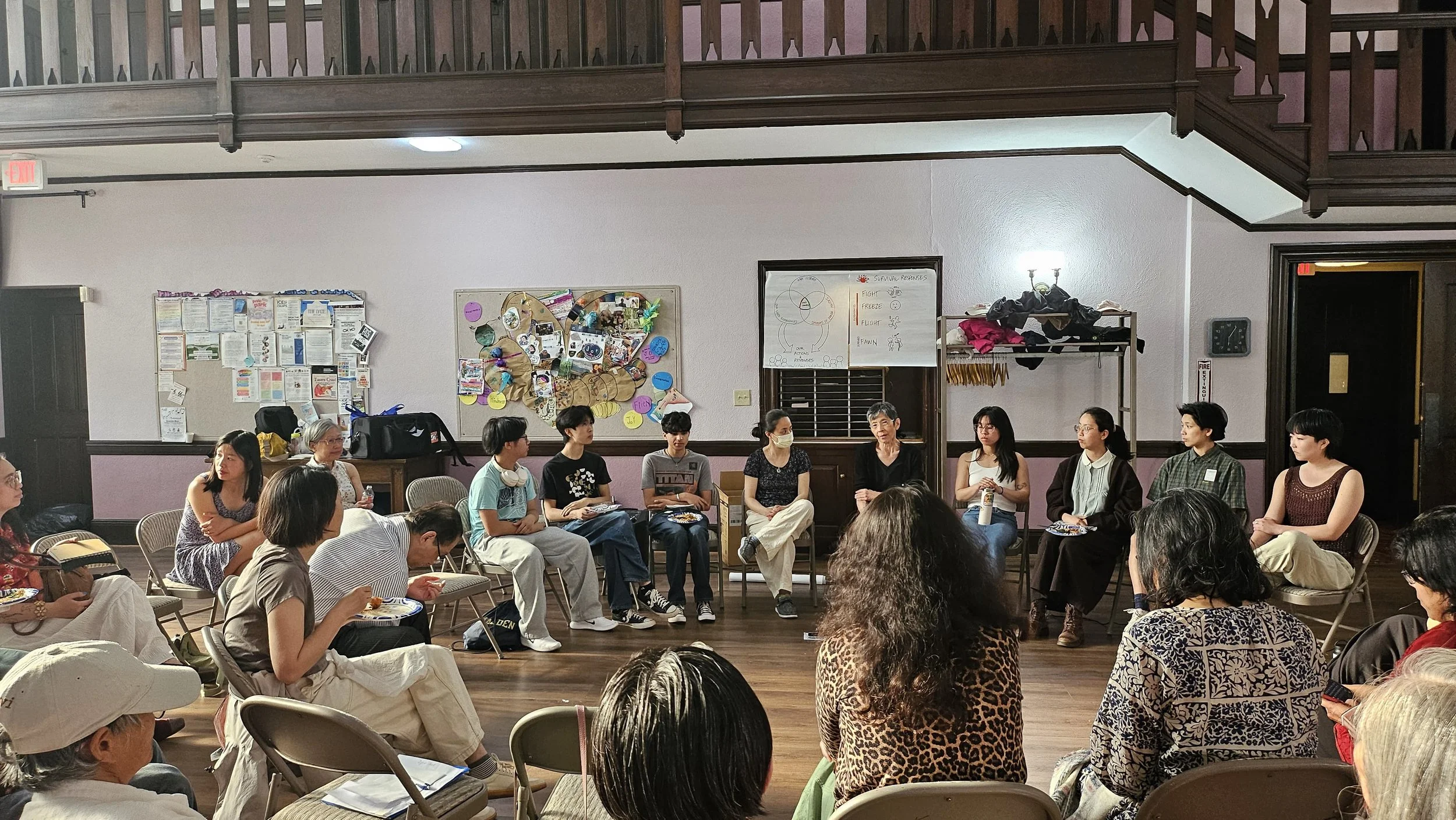
AAPI Ethnic Studies Community Conversation
This year, GMAACC partnered with Dr. Jean Wu and Katie Yue-Sum Li on an intergenerational pilot program built around a simple but urgent question: what does it mean to be AAPI right now, in this country, in this moment, and what does it take to understand our own selves to preserve our dignity as well as of others as we navigate various spaces.
The pilot grew out of a shared realization: AAPI Studies too often stays trapped in the classroom. The theoretical disconnects from the real, intergenerational lives people actually live. So instead of a traditional course, Dr. Wu and Katie built something different: six weeks of community conversation grounded in people’s lived experience, weaving together AAPI history, our day-to-day realities, and the systems of power that shape both. Using Theater of the Oppressed techniques, participants engaged in role-play and other theater techniques to revisit past moments of bias and harm, reimagining the scenarios and trying different ways to respond.
Participants ranged from high school students to elders in their seventies, each bringing a different generation's relationship to what it means to be AAPI. Together, they built what one participant called “a brave space rather than a safe one,” a place where discomfort was welcomed instead of avoided and where sharing a personal story became a way of understanding a shared system. Many described leaving with a new, more compassionate understanding of their own families.
On June 6, GMAACC opened this work up to the wider community with a public roundtable at First Parish Church, where Dr. Wu, Katie, and pilot participants reflected together on what the program meant to them. The room moved through laughter, long pauses, and tears as participants traced the threads connecting their own stories back to a much larger AAPI history like “a flashlight illuminating the same shared system,” as Dr. Wu put it.
This is only the beginning. GMAACC is expanding this work into a recurring series, continuing to build community-rooted spaces where AAPI history, art, and collective memory can meet.
We are deeply grateful to Dr. Jean Wu and Katie Yue-Sum Li for their years of leadership in AAPI Studies and their generosity in bringing that work directly into our community. We also thank the Malden Community Connections Grant and Mass Humanities for their support in launching and expanding this program, and every participant who showed up, shared their story, and helped build a space that so many are still carrying with them.
Keep an eye out for more information on how to join the next cohort.
