
Interview With Diana Jeong
This summer, I had the pleasure of getting to interview longtime Malden resident and GMAACC co-founder, Diana Jeong. I’d heard about her and came across an article in the local news talking about Diana’s father. He had been born in San Francisco in 1882, and eventually moved to Malden as part of his pursuit of building a restaurant business.
I was immediately hooked; there’s something so alluring about hearing these Asian American narratives woven into the fabric of the past.
Rarely do I get a chance to meet other 3rd generation Asian Americans my age or older, and so this opportunity to talk with Diana is one I’m immensely grateful for. Through this interview, I learned more about her perspective as a Malden-raised Asian American—how things have changed and stayed the same over time, and where GMAACC fits into all of it.
– Abby
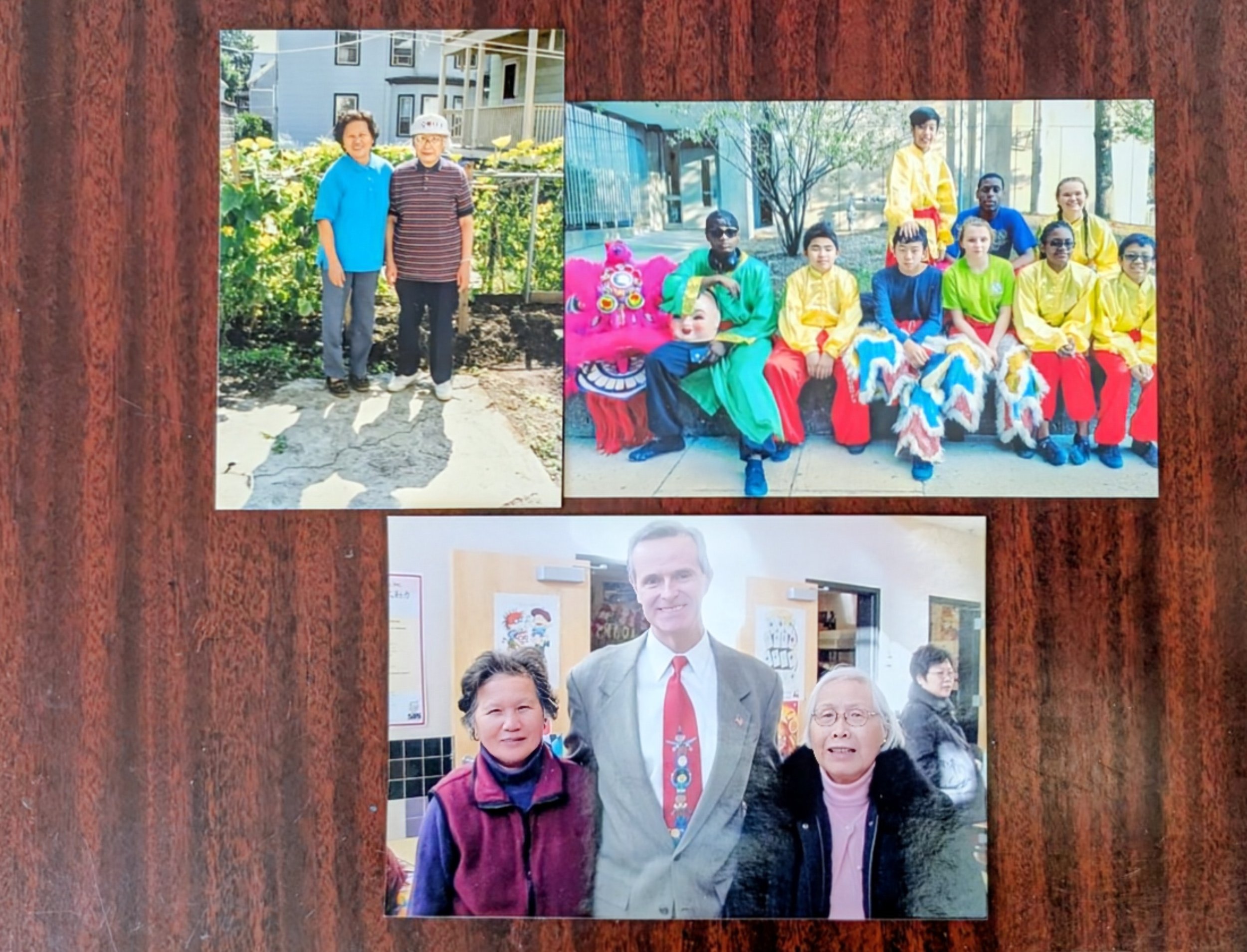
Top Left: Diana’s mother and neighbor, Mrs. Li, in front of their garden; Top Right: Diverse group of Wah Lum students before a performance at Malden High School; Bottom: Diana’s mother, Mayor Richard Howard, and Mrs. Li at a Lunar New Year celebration at the Beebe School.
Me: How did the creation of GMAACC come about?
Diana: I think I need to go back before GMAACC. For a long time, the Asian population in Malden was few and far between, but then with the 1990 census, there was an appreciable increase—about 5 or 6% of the population. And a few people thought, well, maybe we should do something that benefits the Asian community.
There were a couple of things happening approximately within that time range. One was called MAPAC. I can't remember exactly what, but it was something like “Malden Asian Pacific American Coalition”. We did a few things. Basically, we started the Lunar New Year celebration. We worked with the local access TV station, which was called MATV at that time, to do a television program in Cantonese and Mandarin specifically for the Asian population. They'd have certain segments like health and immigration and all that was like a weekly, hour long program. A few years later, there was a big falling out, some folks went their separate ways, and a new nonprofit called Asian Spectrum was formed, specifically highlighting the cable access TV program. Then somewhere in the mid-90s, the Chinese Culture Connection came in.
And this is really good, but [Mai said] there's still a need for social services, for everything else that doesn't fit in. We can work together, but there's a lot of needs, like access to services the city provides, translation services, what's going on politically, that type of thing. [In Sifu Mai Du’s] kitchen on Adams Street, about 11 years ago, she had a whole bunch of folks come in, literally sit around the kitchen table, and talk about what we can do.
We got some seed money, and we hired a part time Youth Coordinator. We recruited a lot of students from Malden High School to do a needs assessment. They went around with surveys, and there were all kinds of findings. People were interested in the services, workforce development, health. It was a fairly comprehensive survey.
In the 1990 census, the Asian population was about 5-6% of the total population. Now, in 2020, we're looking at about 20-25%. You can see how diverse [Malden High School] is—it was nowhere near that when I was in high school.
I think there is a good reason to have a community center, because it sort of establishes you firmly in the community. We're not like a fly by night. With MAPAC and Asian Spectrum, there wasn't any space, it was just volunteers spending their time. There wasn't any succession planning, it was just sort of moving along. There's a lot to be learned about how to sustain the organization…to have a community center [is to be] part of the community. You're not going to go away, you have to work and work things out. And I think that's sort of the way to think about it…you really are established in the community.
Me: You mentioned the 1990 census was when the Asian population was at 5%—what was it like prior to that, growing up in Malden, and when did you start to see a shift?
Diana: I think there had always been Chinese people in Malden, but few and far between. When I was growing up, there were four or five families, and we all knew each other. We all went to school together, we were raised Christian…but as I said, it was few and far between, and we kind of all knew each other.
The grocery shopping was in Chinatown. Any social activities were in Chinatown. My father knew a lot of the vendors in Chinatown because of the restaurant, you know, you'd buy supplies and such […] You bought your Chinese groceries in Chinatown. You had your parties in Chinatown. Your Family Association was in Chinatown. If you wanted to go to Chinese school, that was in Chinatown.
The problem is that it was not always a good section of the community. The 70s was specifically bad for Chinatown, because that's when the combat zone started to encroach. Then Tufts Medicine also expanded. A lot of urban renewal in the 60s sort of expanded, so the actual footprint of Chinatown was kind of being squeezed. Plus, with the combat zone, there was a lot of crime. The expansion of the MBTA to Malden Center and Oak Grove (and the red line to Quincy)...was kind of [a] catalyst [from the mid 70s through the 90s]...that's when you started to see a shift in the population.
At that time, it was more families—the mother and father and the kids, and the kids who go to school. What you're seeing now is folks moving in, there's still people buying, but it's way not affordable like it was (you get a lot of international students of the wealthier sort).
That was sort of how the population grew. I'm going from knowing everybody to knowing a few people. You’ve got a lot of very, very good restaurants here. You've got a couple of grocery stores here. I think a lot of the family associations are still in Boston, but there's less reason to go to Boston now.
Me: I'd love to hear more about your family’s restaurant!
Diana: My father went to New York, became lifelong friends with what we call uncle Eddie, to learn the restaurant trade. And there was this opportunity during the Second World War to buy this restaurant. At the time, that particular location was called The Good Earth. The Good Earth was a book by Pearl Buck.
Me: Oh wow, that’s infamous in Asian American Studies. [Note: The Good Earth was adapted into a movie in 1937, which featured white actors in yellowface. The film then went on to win several Academy Awards, and has since attracted much criticism from the Asian American community.]
Diana: Hopefully [now there’s] a progression of attitudes about what it means to be an Asian, or what it means to be, you know, a person of color. But I think why they did that was because, again, the Asians were few and far between in Malden, when that restaurant was open. That's approximately the time when the book came out, and then shortly after the movie came out. So rather than being “more exotic”, The Good Earth was in the people's consciousness because of the book and the movie. My father bought [it], and he changed it to the Jade Restaurant, which is more amenable, as far as not offensive [goes]. And jade is good luck and all that business.
He did expand the footprint of the restaurant. His help was other Asians, some of whom are relatives. And I got to tell you, don't, don't ever hire your relatives. But that's another story. A lot of the kitchen help was in the back, and they were all Asian. But the waitresses were white women. A lot of it was because there weren't that many Asian women [due to] immigration issues and such. [Note: This would have dated back to the Page Act of 1875, which banned the importation of involuntary laborers and prostitutes, but was primarily enforced against Chinese women.]
Later on, there was another restaurant that was called the Gold Coin, and that's on the corner of Main and Center Street. And then the restaurant had a fire, and my father never went back into the restaurant business. He sold it to another group of people, and they did what they did with it. I think it went through a couple of different hands. Then I think the building was torn down to have the current set of market rate apartment houses there.
One of the good things that happened was because my father knew all the retail businesses—the jewelry store, the guy that repaired the TVs, you know. He knew all those folks and did business with them, and they did business with him. So it was kind of a “community” of business people that you don't have anymore.
There were like four or five department stores all along Pleasant Street, there were movie theaters, and there was a lot of walking traffic at that time. [Nowadays], people walk because they're walking from the T station, walking to their cars to go to the restaurant. So even though you get some walking traffic, it's not like, “let's look in the store”.
I think they're trying to bring that back with pop up stores. On Pleasant Street, there's a farmer's market every Wednesday,
Me: How has your understanding of being Chinese / Asian American changed over time?
Diana: I think it has definitely progressed. When I was in school, there were not too many Asian kids, so there was a lot of trying to conform, you know, to what everybody else was doing. You were sort of looked at as more exotic. “Do you speak Chinese? Say something in Chinese.”
I probably was not brave enough or strong enough to say, “well, cut it out, you jerk”. Probably should have, but then I’d get beat up, I don't know.
My parents also were more trying to work to conform, rather than to be more insulated, although they still kept the holidays and the traditions and sometimes the superstitions. I don't speak [language] as well as I should have because I was allowed to speak English more, and I think a lot of the traditions were not explained as well as maybe they should have been to me. We celebrated Christmas and the regular January 1st New Year (although the Lunar New Year was still very, very, very important). We didn't go to Chinese school. My father tried to teach me calligraphy. He had very beautiful handwriting. I made all these black blobs with the ink. That was sort of the extent of my cultural education.
I wish there were more opportunities when I was growing up. I think if I had children, I would probably send them to a Chinese school. I think I would try to have them appreciate the holidays, and what it means for the Lunar New Year. I think I would want to have a better understanding of that.
I think that if you don't keep it, you lose it. And I'm kind of not sure that people are willing to keep their traditions. I don't know. Hopefully we have progressed from where I was to where you are now and when you have kids.
If you tell my story, or you tell your parents’, that's a fuller history. You are getting a more broad, ranged experience, rather than just one group of people's perspective. It’s sometimes not pretty, and I grant you that, but it is a fuller story.
I think if you don't know the hardships that people faced, then you will never appreciate where they are today.
Me: What does home mean to you?
Diana: On the most basic level—and people don't always have this—[home] is a roof over your head, heat, hot water. In a broader sense, home is something that is convenient for me—I know the neighborhood, I can travel to the grocery store or to transportation, [it’s] something that's familiar to me. There’s a saying that home is where the heart is. And I know that's kind of trivial, but it's also true.
I wanted to sell my old house a long time ago when my mother was still alive, and she resisted for the longest time…I said, “Oh my God, you're driving me crazy”. But I think after she passed…I think for her it really was where her heart was.
My parents made a lot of financial sacrifices to buy this house, with all its nooks and crannies and, you know, leaky this and that. But it was an accomplishment for them to be able to have roots, and the community. To have friends there, to be familiar with the neighborhood…It's where she felt she belonged. This is my home. I'm staying here. I love it here.
And I think that's really kind of important. It's not something you could measure, you know, number wise, but it's just, “I want to be here”. Home is where you want to be, that you love it here. And you might change your mind in a couple of years, but right now, this is where I want to be. I like it here.
You can check out Diana’s interview with Neighborhood View here:
https://neighborhoodview.org/2020/02/29/from-san-francisco-to-malden-my-fathers-journey/
